
If you do a Wikipedia search on the phrase ‘Open to interpretation‘, you’ll notice that the phrase is commonly used when a concentration of nerds has been unable to agree upon whether a piece of Dr. Who or Star Trek fiction qualifies as ‘official canon’.
Whether this tells us more about those show’s fan-base than the quality of the writing is, well, open to interpretation… Was the writing so bad that the viewer can’t tell if it should be taken seriously? Or did they simply not like what they saw and so, seek to argue against its credibility?
It’s certainly a great way to encourage dialogue about your work.
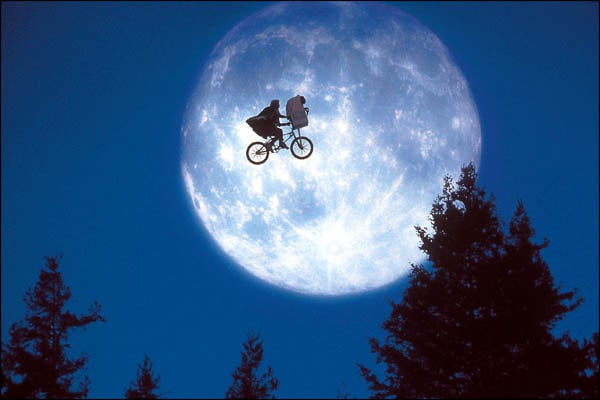
It can be applied to anything, by anyone with an imagination. The end of the E.T. plot summary, for example, ends with “E.T. then picks up the flower pot Gertie gave him, walks into the spaceship, and takes off, leaving a rainbow in the sky…”
I could easily append; “It is left open to the viewer’s interpretation as to whether the ship subsequently crash-lands, prompting Caspar Weinberger, seeing this as an act of aggression, to mobilize a US military response to the alien threat, and launch an offensive against the planet Brodo Asogi…”
Hey, I’m allowed to dream aren’t I?

HOWEVER, I’m finding more and more that writers feel the need to explain every single little detail of the universes they’ve created. Rather than just let the audience experience it. They seek to fill in all the blanks so that there is no interpretation – at all – to their intention.
The original Fallout games, for example, created an engaging and intriguing world for us to experience. We got it! Yet the front page of the Fallout 3 manual explains to us exactly why the world of the future is stuck in the 50’s…
“Imagine if, after World War II, the timeline had split. Our world forked into one branch, the Fallout universe the other. In that other branch, technology progressed at a much more impressive rate, while American society remained locked in the cultural norms of the 1950’s. It was an idyllic “world of tomorrow,” filled with servant robots, beehive hairdos, and fusion-powered cars. And then in the year 2077, at the climax of a long-running war with China, it all went to hell in a globe-shattering nuclear war.”
THERE! Job done. No need to use any imagination whatsoever!

Personally, I like the less is more approach. We don’t know why Bowser wants the princess, or what’s in it for Mario if he rescues her. We don’t need to know what’s in the suitcase in Ronin in order to enjoy the movie. We don’t need to know what caused the zombie infection of Left 4 Dead. Just put us in the world, dammit! If the picture is captivating enough, we won’t be worrying about the ‘missing pieces’ of the puzzle but simply enjoying the ride.
-Stew (@chicknstu)